Flow State Invitational
Superfights and Quintet, live from Shark Pit BJJ.
Superfights
$30.00 + fee — $34.50 total
Register, and your callout goes on the board. Another athlete takes the match, you both confirm, and the organizer co-signs it. The purse starts at both entries and anyone can add to it.
See the boardQuintet
$100.00 per team + fee — $115.00 total
Men's and women's teams of up to five under a combined weight cap, winner stays on, submission only. A draw eliminates both athletes, so there is no running out the clock.
Enter a teamSponsors
$100 to $1,000
Your logo on the broadcast and the event page. Gold and Platinum include a commercial played during the stream.
Become a sponsorQuintet rules
Quintet — team grappling
Two teams. One athlete from each side starts. The winner stays on and faces the next athlete from the opposing team. A team wins when every athlete on the other side has been eliminated.
Building a team
- A team is up to five athletes, entered in the running order you choose when you sign up. Position 1 goes out first.
- Men's teams: 948 lbs (430 kg) combined or under. Women's teams: 617 lbs (280 kg) combined or under.
- What matters is the team's total, not its head count. There is no individual weight limit.
- There is no weight tolerance. The team is under the cap or it is not.
- A team of four that makes weight is a legal team. If your five are over on the day, drop athletes until the team is under the cap — a dropped athlete is out for the event and that slot is gone.
- Teams are men's or women's. No mixed teams.
- Anyone the team picks may enter it and pay the buy-in — captain, coach, or whoever handles it.
- The running order may be edited until registration closes. It is final from that moment and is confirmed at weigh-ins.
- Every athlete weighs in before the team's first match. Weigh-in times are announced before the event.
- 16 and over. Every athlete signs the participant waiver when they register. Athletes under 18 need a parent or guardian to countersign that waiver.
- Mouthguards, cups and rashguards are optional. Come clean, with short nails.
Uniform
Quintet is usually no-gi, but a division may be run in the gi. Which it is this event is declared in the division listing.
- No-gi: shorts, spats, or shorts over spats, with no zippers, buttons or pockets. A rashguard is optional. Gi pants are allowed but may not be grabbed.
- Gi: a clean, undamaged gi of any colour. Normal gi grips are legal.
Matches
- 8 minutes, submission only. No points, no advantages, no decisions.
- Where two opponents differ by 44 lbs (20 kg) or more on men's teams, or 15 lbs (7 kg) or more on women's teams, the lighter athlete chooses whether that match runs 8 minutes or 4. Weigh-in numbers decide the difference.
- That choice is made once both athletes for the next match are known and the table has confirmed the gap. It is declared to the referee before the match starts and is then final. If the lighter athlete does not choose, the match runs 8 minutes.
- A draw eliminates both athletes. Stalling costs your team a body as surely as a loss does.
- Stalling: first offence a warning, second offence a warning, third offence a disqualification. Only the offending athlete is eliminated — the opponent is credited with the win and stays on.
- A winner who stays on gets one minute before the next athlete comes out.
- Coaching is allowed from the designated corner only.
- If the referee or medical staff stops a match for injury, the injured athlete is eliminated and the opponent stays on.
Forfeited slots
If an athlete listed in a team slot does not appear, was dropped to make weight, or cannot compete, that slot is forfeited. It may not be filled or reordered. When the running order reaches it, the opposing athlete is credited with a win and stays on, without a match.
A team with no eligible athlete remaining has lost the match. That includes a team reduced to zero by weight-cap drops, forfeited slots, injuries, disqualifications or eliminations.
A team that does not appear at all forfeits: the opposing team advances on a walkover and the buy-in is not refunded.
If both teams are wiped out
Both teams can go out at the same moment, when the last athlete from each side draws.
1. The team with the most submission victories takes it. Only wins by submission count — draws, disqualifications, injury stoppages, forfeited slots and walkovers do not, and the drawn match that wiped both teams out gives neither team a submission. 2. If those are level, each team names one athlete. Any athlete on the submitted roster who is present, made weight and is medically cleared, whether or not they have already competed. An athlete who was dropped at weigh-in, disqualified or withdrawn is not eligible. 3. That match starts in 50/50 and runs to the first score under the Flow State points system, below. The referee sets both athletes in the position and confirms it before starting, and restarts them there after any interruption that produced no score. 4. A submission also ends it. So does a disqualification or an injury stoppage, in the other athlete's favour.
The Flow State points system
Nothing is scored during a normal match in either format. This settles a deciding match only — the Quintet wipe-out decider above, and a superfight overtime restart.
| Action | Points |
|---|---|
| Takedown | 2 |
| Sweep | 2 |
| Guard pass | 3 |
| Knee on belly | 2 |
| Mount | 4 |
| Back control (hooks or body triangle) | 4 |
| Back mount (belly down, no hooks) | 4 |
Points are awarded after three seconds of control. There are no advantages and no partial scores.
Prize
The winning team takes a fixed prize, announced for each event. It is not funded from the buy-ins and does not vary with the number of teams entered.
Legal techniques
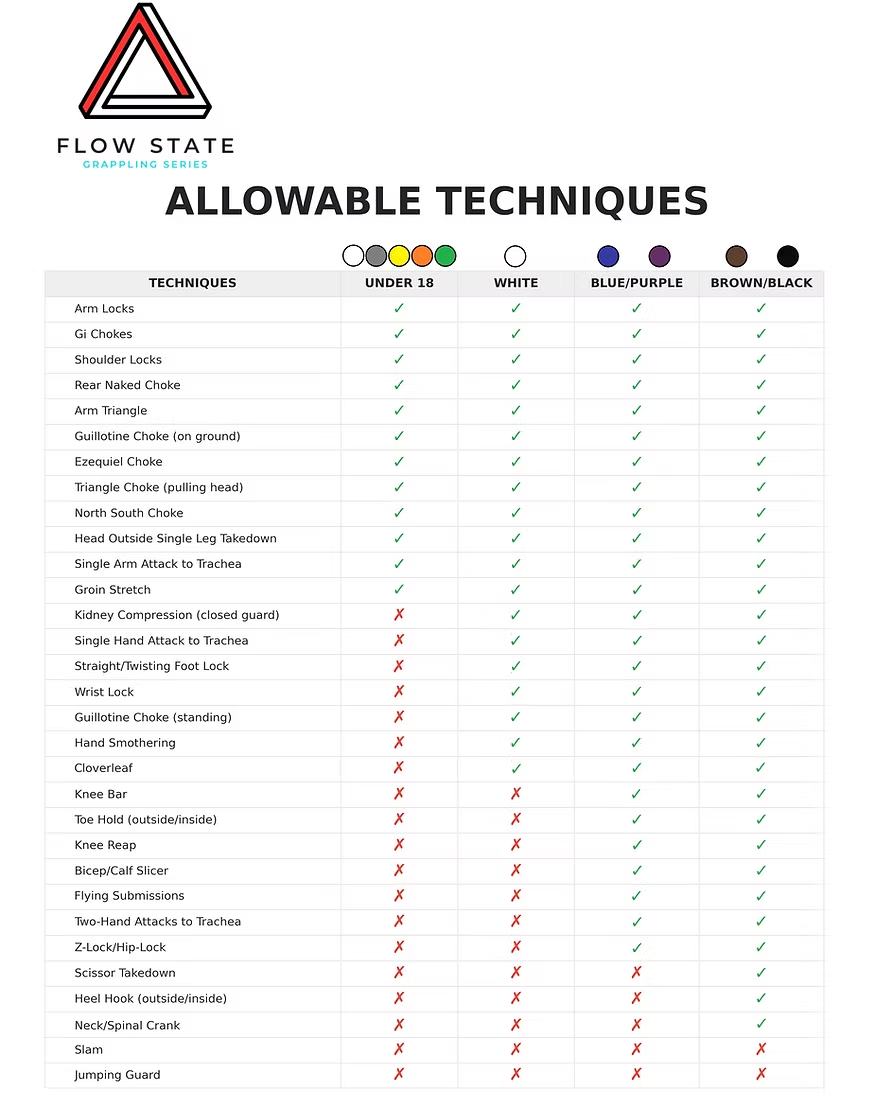
The Flow State allowable-techniques chart governs. Each row adds to the rows above it.
| Allowed for | Techniques |
|---|---|
| All eligible athletes, including 16 and 17 year olds | Arm locks, gi chokes, shoulder locks, rear naked choke, arm triangle, guillotine on the ground, Ezequiel, triangle pulling the head, north-south choke, single-arm attack to the trachea, groin stretch |
| Adults, white belt and up | Kidney compression from closed guard, single-hand attack to the trachea, straight and twisting foot locks, wrist locks, standing guillotine, hand smothering, cloverleaf |
| Blue and purple belts and up | Knee bars, toe holds (outside and inside), knee reaping, bicep and calf slicers, flying submissions, two-hand attacks to the trachea, Z-lock / hip lock |
| Brown and black belts only | Scissor takedowns, heel hooks (outside and inside), neck and spinal cranks |
| Nobody | Slams, jumping guard |
Ordinary takedowns are legal at every level. Scissor takedowns are brown and black only. Slams, and any takedown that spikes an opponent on the head or neck, are illegal for everyone.
Also always illegal: small-joint manipulation, striking, eye gouging, hair pulling, biting. Aoki locks are treated as heel hooks.
Flying submissions and slams. An intentional slam is illegal. Where an athlete attacks a legal flying submission, the opponent has no duty to prevent a slam — the referee decides whether the opponent's return to the mat was a legal defensive takedown, an unavoidable fall, or an illegal slam. An illegal slam is a disqualification.
When athletes of different ranks meet, the lower rank's allowances apply to both. Rank is self-declared.
Any technique the referee judges to be applied with intent to injure rather than to submit ends the match immediately in favour of the opponent, judged within reason and within the bounds of normal BJJ competition.
Superfight rules
Superfights
A superfight is one match between two athletes who chose each other on the board. Both entries go into the purse, anyone can add to it, and the winner takes it home.
There are no brackets and no weight classes. Athletes match up any way they like, on whatever terms the two of them agree.
The match
- 10 minutes, one round.
- Submission wins. No points and no advantages are kept.
- A superfight never ends in a draw. A winner is always selected.
- If the time expires with no submission, the referee awards the match to the athlete with the better jiu-jitsu — the one who came closer to finishing. More genuine submission attempts, better position, the more dangerous athlete.
- Where the match is so close that the referee and judges cannot separate the two, they may restart both athletes in 50/50. The first athlete to score under the Flow State points system — set out in the Quintet ruleset above — or to submit their opponent, wins.
- Any technique the referee judges to be applied with intent to injure rather than to submit ends the match immediately in favour of the opponent, judged within reason and within the bounds of normal BJJ competition.
- If the referee or medical staff stops a match for injury, the match goes to the opponent.
Gi or no-gi
Decided per match, when the matchmaking happens. At registration each athlete says whether they want gi, no-gi, or either, and that is used to match them. What the pair agreed is shown on the board.
Choosing the ruleset
The two athletes agree their ruleset before the match, from the Flow State allowable-techniques chart. There are three:
- White belt rules — everything in the first two rows of the chart.
- Blue and purple rules — adds the blue and purple row.
- Brown and black rules — adds the brown and black row, heel hooks included.
These names describe technique packages, not rank eligibility: any two athletes may agree any tier, whatever their ranks. They may also agree to less — a whole lower tier, or specific techniques struck out of the tier they picked — and nothing may be added above the tier they agreed.
It is the athlete's obligation to have read these rules and to understand them. The agreed set is recorded on the match card and cannot be changed after the organizer co-signs.
Always illegal in a superfight
Whatever the athletes agree: slams, spiking on the head or neck, small-joint manipulation, striking, eye gouging, hair pulling, biting, jumping guard. Aoki locks are treated as heel hooks.
Flying submissions are legal only if the agreed tier includes them. Where they are, the opponent has no duty to prevent a slam — the referee decides whether the opponent's return to the mat was a legal defensive takedown, an unavoidable fall, or an illegal slam. An illegal slam is a disqualification.
Weight
There are no weight classes. Each callout names the weight the two athletes are agreeing to, and any tolerance is whatever they agree between themselves — there is no ceiling and no house limit.
Both athletes weigh in before the match. An athlete who misses the agreed weight forfeits, unless the opponent agrees to go ahead. The match then proceeds only if both athletes agree and the staff approve; the staff may refuse on safety or scheduling grounds but do not impose conditions of their own. The forfeiting athlete's entry is not refunded.
Once a match is made
When the organizer co-signs, the match is made. If one athlete cancels or does not appear, the opponent who shows up automatically wins the pot. There is no cancellation window and no return to the board.
Money
- 16 and over. Every athlete signs the participant waiver when they register. Athletes under 18 need a parent or guardian to countersign it.
- Each athlete pays the posted entry plus the processing fee; the full entry reaches the purse.
- The purse is both entries plus every contribution. Contributions are not wagers and nothing is returned to contributors whatever the result.
- The organizer pays the winner after the event.
- An athlete nobody matched with before registration closed is refunded in full, fee included.
Conduct
- No-gi: shorts, spats, or shorts over spats, with no zippers, buttons or pockets. Gi: a clean, undamaged gi of any colour. Mouthguards, cups and rashguards are optional. Come clean, with short nails.
- Stalling: first offence a warning, second offence a warning, third offence a disqualification.
- The referee's decision is final. Corners may not enter the mat.